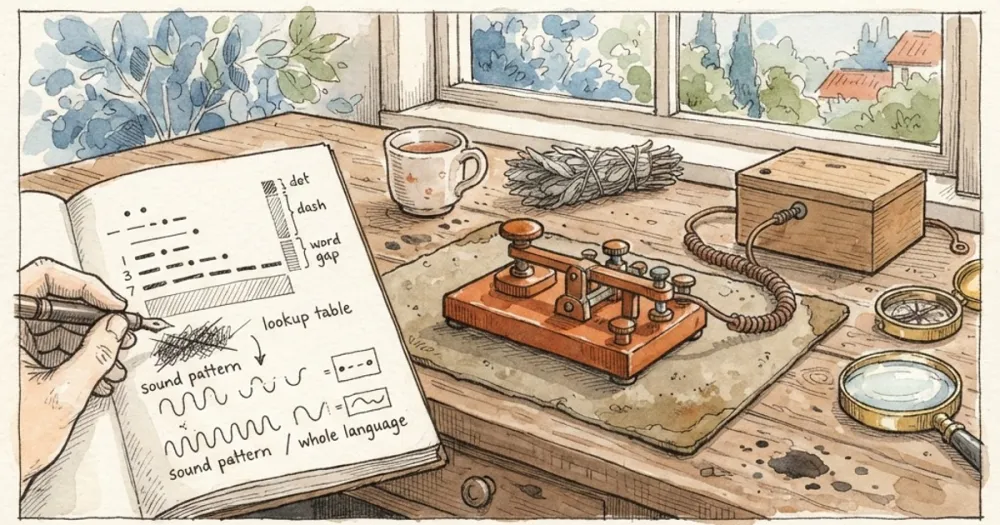
Morse code is a variable-length encoding designed around letter frequency: E is a single dot, T a single dash, and the rarest letters get four or five elements. Samuel Morse's collaborator Alfred Vail worked the frequencies out by counting type in a printer's case.
The structure
There are only two symbols, but there are four durations, and the durations carry as much information as the symbols.
- A dot is one unit.
- A dash is three units.
- The gap between elements within a letter is one unit.
- The gap between letters is three units.
- The gap between words is seven units.
That ratio is the whole standard. Speed is set by choosing how long a unit is; the proportions never change. This is why Morse survives terrible signal conditions - the receiver only has to distinguish short from long, not decode a waveform.
Free toolMorse Code TranslatorTranslate text to Morse code and Morse back to text, covering letters, digits and punctuation. Runs in your browser with no signup.Writing it down
In text, a space separates letters and a slash separates words:
... --- ...        SOS
.... . .-.. .-.. --- / .-- --- .-. .-.. -..   HELLO WORLD
Some sources use three spaces instead of a slash for a word break. Both are common and neither is wrong; the slash is less ambiguous when the text is copied around.
Morse has no case. Decoding always produces uppercase, because the encoding never carried the distinction.
What SOS actually is
Not an abbreviation. It does not stand for save our souls or anything else - the phrase was invented afterwards to explain a signal that was chosen purely because ... --- ... is an unmistakable rhythm that nothing else resembles.
It is also usually sent as one continuous nine-element sequence with no letter gaps, which is why it is written with an overbar in formal notation.
How to learn it
The instinct is to memorise a table of letters to patterns. This works and it caps you permanently at around five words a minute, because every character requires a conscious translation step.
The methods that work teach it as sound:
Koch method. Start with two characters sent at full target speed - 20 words per minute or faster. Copy them until you hit 90% accuracy, then add a third. You learn each letter as a rhythm rather than as a sequence of marks.
Farnsworth timing. Send individual characters at full speed but stretch the gaps between them. This gives you thinking time without letting you count dots, which is the habit that stops progress.
Both exist because the failure mode is well understood: anyone who learns Morse visually has to unlearn it before they can go fast.
Where it is still used
Amateur radio, daily and enthusiastically - CW gets through when voice does not, using a fraction of the power. Aviation navigation beacons identify themselves in Morse, which pilots still verify by ear. It remains in maritime distress procedure as a fallback, and a lamp or a torch works when nothing electronic does.
Punctuation and numbers
Digits are all five elements, running from ----- for zero through .---- for one to ----. for nine. There is a shorthand set used on air where some digits are abbreviated, but it is not standard.
Punctuation is defined for period, comma, question mark, apostrophe, slash, brackets, colon and a few others. In practice operators use very little of it - the prosigns that manage a conversation get far more use than the full stop.
Convert either direction with the Morse code translator.