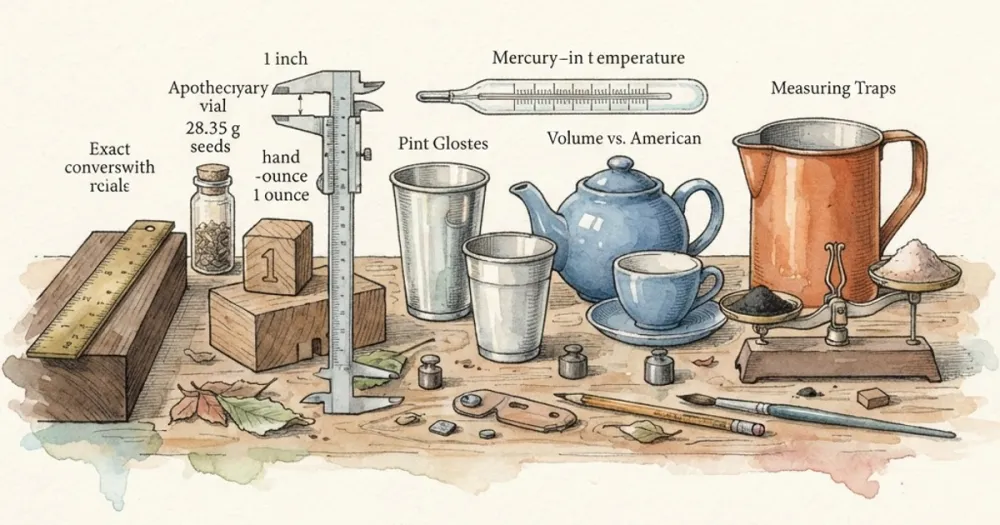
Since 1959 the imperial and US customary systems have been defined in metric terms. That makes most conversions exact rather than approximate, and it means rounding errors in a spreadsheet are your fault rather than the system's.
The exact ones
- 1 inch = 25.4 mm, exactly
- 1 foot = 0.3048 m, exactly
- 1 mile = 1609.344 m, exactly
- 1 pound = 0.45359237 kg, exactly
- 1 ounce (weight) = 28.349523125 g, exactly
There is no approximation in any of these. If a conversion looks like it lost precision, something rounded on the way.
Free toolUnit ConverterConvert between metric and imperial units for length, weight, volume, time, digital storage and temperature, with exact conversion factors.Volume: where it goes wrong
Length and weight units are shared between the US and the UK. Volume units are not, despite having the same names.
| Unit | US | Imperial |
|---|---|---|
| Fluid ounce | 29.57 ml | 28.41 ml |
| Pint | 473 ml | 568 ml |
| Gallon | 3.785 l | 4.546 l |
An imperial gallon is about 20% larger. This is why UK and US fuel economy figures in miles per gallon are not comparable, and why a British pint of beer is noticeably bigger than an American one.
Worse, a US fluid ounce is larger than an imperial one while a US pint is smaller, because the imperial pint contains 20 fluid ounces and the US pint contains 16.
Cups are worse
There is no single cup.
- US legal cup: 240 ml
- US customary cup: 236.6 ml
- Metric cup (Australia, NZ, Canada, much of Europe): 250 ml
- Imperial cup (historic UK): 284 ml
A recipe written in Australian cups and cooked with US cups is out by about 6% per cup, which is enough to ruin bread and meaningless in a soup. Baking by weight avoids the entire problem, which is why professional recipes are written in grams.
Temperature needs a formula, not a factor
Every other conversion is a multiplication. Temperature is not, because the scales have different zero points.
- C to F: multiply by 9/5, then add 32
- F to C: subtract 32, then multiply by 5/9
- C to K: add 273.15
The order matters. Adding 32 before multiplying gives a number that is wrong and looks plausible. -40 is the one temperature where both scales agree, which is a useful sanity check.
Digital storage: 1000 or 1024
Both, depending on who is speaking.
Operating systems and developers use powers of two: 1 KB = 1024 bytes. Storage manufacturers use powers of ten: 1 TB = 1,000,000,000,000 bytes. This is why a 1TB drive shows as roughly 931 GB after formatting - nothing is missing, the two parties are using different definitions of the same word.
The unambiguous names for the binary units are kibibyte, mebibyte and gibibyte, standardised in 1998 and used almost nowhere outside documentation.
Practical rules
- Convert once, at the end. Chained conversions accumulate rounding.
- Keep the raw value and the unit together in any dataset. A column of numbers with the unit in the header is a bug waiting for a schema change.
- For anything scientific, work in SI throughout and convert only for display.
The unit converter uses the defined exact factors, and US definitions where the two systems diverge.