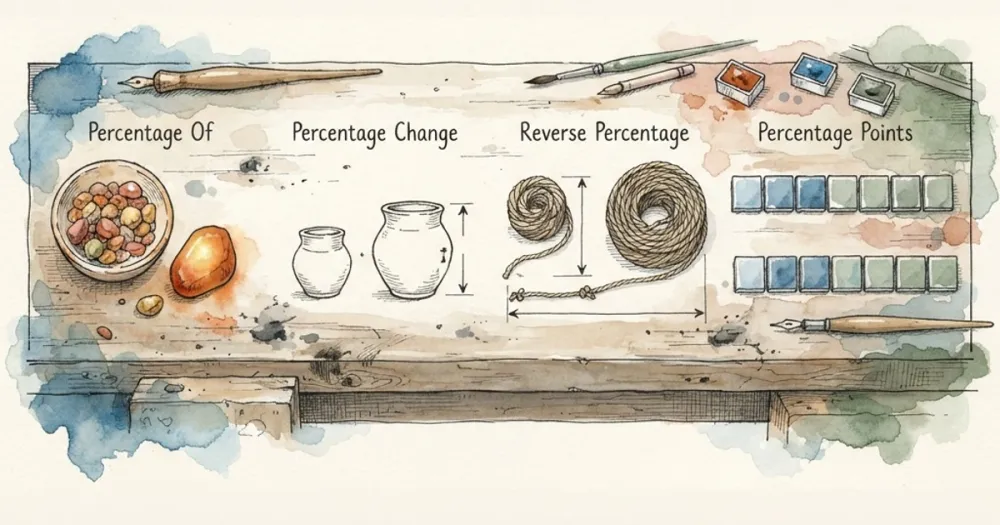
Almost every percentage mistake is a mismatch between four calculations that look similar and are not. Getting them straight takes about five minutes and stops a whole category of quiet spreadsheet errors.
The four calculations
What is X% of Y? Multiply. 15% of 240 is 240 x 0.15 = 36. Converting the percentage to a decimal first is the whole trick.
X is what percent of Y? Divide, then multiply by 100. 36 out of 240 is (36 / 240) x 100 = 15%.
Percentage change from old to new. (new - old) / old x 100. From 240 to 300 is (60 / 240) x 100 = 25%.
Removing a percentage from a total. Divide. To strip 20% VAT from a gross figure of 120, divide by 1.2 to get 100. Subtracting 20% of 120 gives 96, which is wrong by four.
Free toolPercentage CalculatorWork out X% of Y, what percentage one number is of another, and percentage increase or decrease between two values.The trap in percentage change
The denominator is always the original value. Using the new one gives a different number, and it is a plausible-looking different number, which is what makes it dangerous.
From 240 to 300 is a 25% increase. From 300 to 240 is a 20% decrease. Same two numbers, same absolute gap, different percentages, because the base changed.
This also explains why a 50% fall does not undo a 50% rise. 100 rises to 150, then falls by half to 75. The second percentage is applied to a larger base, so it removes more. To reverse a 50% rise you need a 33.3% fall.
Reverse percentages
This is the one that costs money. If a discounted price is 56 after 30% off, the original is not 56 + 30%. It is 56 / 0.7 = 80.
The general rule: to add a percentage, multiply by (1 + rate). To remove one, divide by (1 + rate). Every tax, discount and markup calculation is one of those two.
Markup and margin are the same trap wearing different hats. A product costing 60 and selling at 100 carries a 66.7% markup on cost and a 40% margin on price. Quoting one when a stakeholder means the other is how pricing meetings go wrong.
Percent versus percentage points
A conversion rate moving from 2% to 3% has risen by one percentage point and by 50 percent. Both statements are true and they describe the same change.
Which one you use is not a stylistic choice. "Conversion improved 50%" and "conversion improved 1 point" land completely differently in a board deck, and the second is usually the honest framing when the starting number is small.
Compounding
Sequential percentage changes multiply rather than add. Three consecutive 10% increases are not 30% - they are 1.1³ = 1.331, so 33.1%.
This matters for anything measured monthly. 5% monthly growth is 79.6% annually, not 60%. Monthly churn of 5% leaves 54% of a cohort after a year, not 40%.
Quick checks
- Percentage change should always be divided by the value you started from.
- To reverse a percentage, divide - never subtract.
- Sequential changes multiply, they do not sum.
- If the base changed between two figures, the percentages are not comparable.
Run the numbers through the percentage calculator if you want to check any of these against a worked example.